

Communicating priorities in a dental practice means turning a strategic choice into rules the team can use in everyday decisions: what changes now, what goes on hold and what to do when two demands compete. It is not about announcing a goal; it is about making clear what gets capacity and what will not be done for now.
A priority is not whatever the owner repeats most forcefully. It is whatever changes the order of decisions, receives capacity and makes clear what will not be done right now.
In a dental practice, the gap between strategy and routine shows up in small conflicts. The front desk tries to fill the schedule, the treatment coordinator speeds up follow-ups with new inquiries, billing asks for complete records and the office manager asks everyone to protect on-time starts. Each instruction sounds right. Together, they can be impossible.
Communicating priorities takes more than announcing a target. The team needs to understand the result you want, the trade-offs it requires, the behaviors that change and the rule for deciding when two demands compete. This article uses an annotated priority letter to show how to do it. It is not about internal communication channels such as huddles and messages, but about the content of the choice those channels have to carry.
Why doesn't the team understand the practice's priorities?
The problem is rarely a lack of messages. It is a lack of choices.
In November 2026, Gallup reported that only 16% of US employees surveyed strongly agreed that their organization's leadership communicates effectively with the rest of the company. The research also found a perception gap: 44% of managers strongly agreed that they clearly communicate company priorities to their teams, while only 26% of individual contributors strongly agreed that their manager does so. The figures come from Gallup's article on leadership communication and cover US workers in general, not dental practices, but they point to a familiar risk: whoever sends the message tends to overestimate how much the other side understood.
In a practice, phrases like "we need a better patient experience", "let's focus on case acceptance" or "billing has to be caught up" can mean different things to each role. The team receives an intention, not a decision.
A well-communicated priority answers five questions:
- What needs to change now?
- Why does it matter?
- What will stop competing for attention?
- How should we act when there is a conflict?
- What evidence will show progress?
Choosing which initiative deserves the team's capacity is an earlier step, covered in our article on project management for dental clinics. The focus here is the next step: getting that choice, intact, to the people who make decisions during the day.
How do you write a priority letter for your dental team?
Below is an example for a hypothetical practice that found many treatment estimates pending a patient decision with no next step recorded. The goal is not a ready-made template, but to show the level of clarity needed.
The letter
Priority for the next 30 days
Our priority is to stop losing continuity after a treatment estimate is presented. This is not about pressuring patients or simply making more calls. It is about making sure each person is clear on the next step, and that the practice can tell a decision in progress from a closed case.
During this period, every pending estimate will have an owner, a date for the next action and notes from the last contact. We will not start a new reactivation campaign until the team can keep this routine without a backlog.
When responding to a new inquiry conflicts with a follow-up already promised, the promise with a set deadline comes first, except for a dental emergency or specific direction from the office manager.
Management will track the age of pending estimates, the share with a next action recorded and the cases reopened because context was missing. After 30 days, we will decide whether to keep, adjust or end the process.
Each paragraph of the letter has a job:
| Part of the letter | Question it answers | In the example |
|---|---|---|
| Problem and result | What must change now, and why? | Stop losing continuity after the estimate |
| Boundary | What does the priority not allow? | Pressuring patients or piling on calls |
| Trade-off | What stops competing for attention? | No new reactivation campaign for now |
| Conflict rule | How do we choose between two demands? | A promised follow-up before a new inquiry |
| Evidence and review | How will we know, and when do we review? | Age of pending estimates, next action recorded, review at 30 days |
What the first sentence solves
"Stop losing continuity" describes the operational problem. It is more useful than "increase case acceptance" because it points the team to the handoffs between presentation, questions, contact and decision.
The sentence also protects the patient by stating what the priority does not mean. A business result does not justify pressure, inappropriate insistence or interference with clinical decisions. The goal is better continuity and better information.
Why the letter names a trade-off
Deciding not to launch a new campaign is what makes the priority credible. If everything keeps getting the same capacity, the new direction is just extra work.
Mature communication names what goes on hold, what gets scaled back and what will no longer be asked for. That keeps the team from guessing which old instruction lost its weight.
How the conflict rule helps
Priorities become clearer when the team knows what to do when two legitimate demands collide. The rule "a promised follow-up before a new inquiry" does not settle every case, but it reduces personal interpretation.
Dental emergencies, safety, confidentiality, professional responsibilities and the treating dentist's instructions stay protected. A business priority should never work around those limits.
Why the letter ends with evidence
Without a measure, the team cannot tell whether the priority is moving. Without a review date, a temporary instruction becomes a permanent rule by inertia.
You do not need a ready-made report for this. The practice can build these measures itself from the records it already keeps and from the discipline of logging every contact.
Should leaders also say what they don't know?
Yes. Trust drops when leaders try to fill every uncertainty with artificial certainty.
Writing about AI transformations in 2026, McKinsey argues that trust isn't built through a single announcement. It is earned through consistent actions over time, a clear plan and honest communication about what the organization knows, what it doesn't know and how decisions will be made. The article is about technology change, but the logic applies to any change that affects people's work.
In a practice, the dentist or office manager might say: "We don't know yet whether the problem is slow follow-up, incomplete patient records or the kind of inquiries we get. For four weeks, we'll improve how we record each case and compare them before changing how we present treatment."
That message is stronger than inventing a cause and demanding a premature fix.
Why isn't repeating the priority everywhere enough?
Repetition helps, but only when the message keeps the same meaning. A priority gets lost in four ways.
Each leader translates it differently. The owner talks about growth, the office manager talks about productivity and the front desk hears that every slot must be filled. Before talking to the team, leaders need to agree on the problem, the trade-off and the conflict rule.
The message never reaches the place where the decision happens. A presentation at a team meeting changes nothing if, days later, someone faces a real situation and does not know where to check the rule. The priority has to show up in the workflow: a task, a short instruction, a field in the record, an agenda item in the morning huddle or hands-on training. Our guide to delegating tasks in a dental clinic shows how to make the owner and the deadline explicit.
Leaders' behavior contradicts their words. If the priority is record quality but the owner asks for shortcuts to close out the day, the team learns that speed is still the real priority.
There is no way to push information back. The team runs into exceptions before leaders do. Without room to report them, communication becomes a one-way order and strategy loses touch with operations. The American Dental Association's tips for communicating effectively in the dental office include using clear and concise language, being mindful of the listener's perspective and accepting feedback.
How can you tell whether the priority was understood?
Don't just ask "does everyone get it?". That question invites a quick yes. Use three better checks.
Reconstruction
Ask different people to explain, in their own words, what changes and what stays the same. Differences between their answers show where the message lost precision.
Application
Present a real conflict. For example, a new inquiry comes in while a promised follow-up is about to fall due. Ask which decision the priority points to and which boundary must be kept.
Evidence
Check whether behavior and records actually changed. A team can repeat the message perfectly and keep working the same way.
Gallup links leadership communication to clear expectations, collaboration and trust. The same research shows that managers and employees see the clarity of priorities differently, which is a reason to measure understanding by the work you observe, not by how confident the speaker feels.
How do you write your next priority in 100 words?
Pick a single business priority for the coming weeks. Write a message of no more than 100 words that covers the problem, the result, the trade-off, the conflict rule and the evidence.
Our article on knowledge management in dental clinics makes a useful point: "we need to communicate better" defines no behavior, deadline or owner. A decision has to say what changes, who is responsible, where it is recorded, when it starts and which result will show it works.
Hand the message to three people in different roles and ask how it changes a real decision. If each gives an incompatible answer, the problem is not the team's attention. The priority has not yet been communicated clearly enough.
How can Pro365 GO data support a priority?
Pro365 GO, the new ProDent that runs 100% on the web, connects scheduling and the front desk, clinical records, treatment estimates, billing, follow-up opportunities and KPIs, with Pro365 AI and support from the HartSystem team. These tools can help put the priority into the workflow, recover context and follow progress.
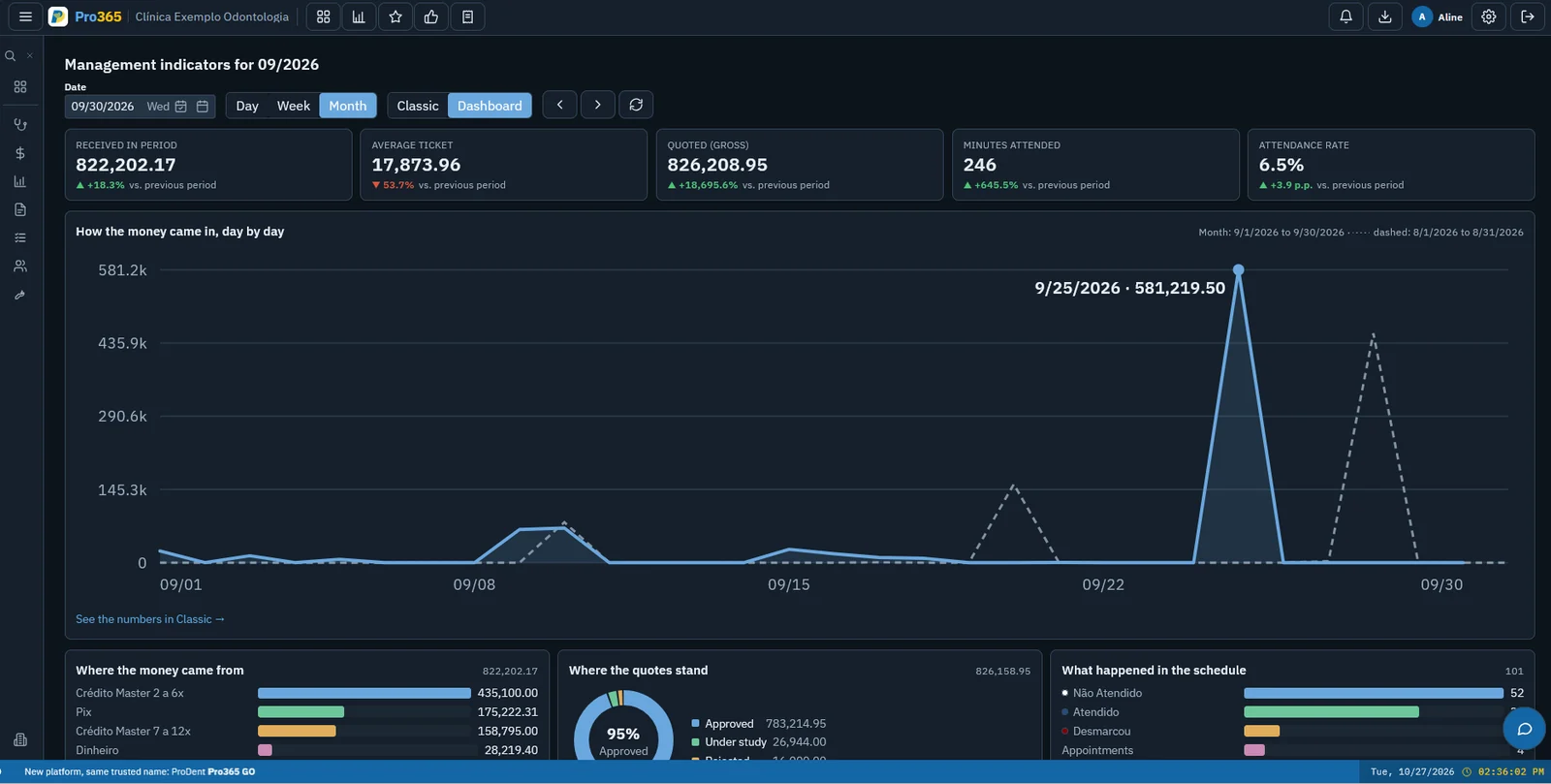
The management dashboard shows the schedule, no-shows, treatment estimates and payments received, compared with the previous period; see which decisions to make from it. The Pro365 AI Consultant answers questions about your practice data through WhatsApp, such as how many estimates are still pending this month, and the Instructor answers the team's questions about how to use the system.

Technology does not choose the priority or resolve contradictions between leaders. The practice is still responsible for deciding what matters now, which capacity it will protect and which side effects it needs to watch.
Book a demo to see the dashboard and Pro365 AI with your own practice data.
Written by the HartSystem team, which has developed ProDent dental software since 1993 and works with practices in Brazil, Portugal, the United States, Mozambique and Paraguay.