
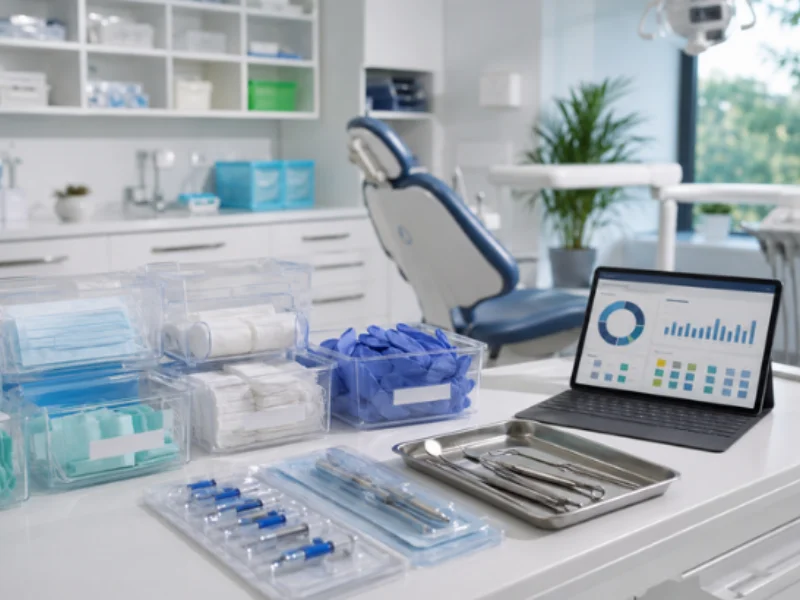
Dental inventory management keeps the right supplies on hand without tying up cash in products that sit on the shelf or expire. It comes down to a simple, consistent routine: know what you have, how fast you use it, when to reorder and who is responsible.
In a dental clinic, inventory tends to feel like a minor administrative detail until the day you run out of anesthetic, gloves, composite, saliva ejectors, orthodontic wire or another essential supply.
When that happens, the impact doesn't stay in the supply cabinet. The schedule runs late, the team improvises, the budget becomes less predictable and the patient experience can suffer.
That's why inventory control shouldn't be treated as just counting supplies. It's part of running the clinic, just like scheduling, patient records, finances, patient service and KPIs.
A clinic that organizes its supplies better can buy smarter, reduce waste, avoid expired materials and better understand the real cost of each procedure.
Why dental inventory management matters
Inventory in a dental clinic directly affects three areas: operations, finances and quality of care.
In operations, it makes sure the team has the right supplies at the right time. In finances, it prevents unnecessary purchases, waste and rush orders. In quality of care, it reduces improvisation and helps keep a safer standard for every procedure.
The problem is that many clinics only notice how important inventory is when something goes wrong.
Some signs are clear:
- the team orders supplies in a panic;
- no one knows exactly what's available;
- products expire before they're used;
- supplies go missing between operatories;
- purchases are made without any usage history;
- the clinic can't forecast recurring spending;
- each provider requests supplies a different way.
When these signs show up, inventory is no longer just an internal routine. It's affecting the clinic's results.
The mistake of tracking inventory from memory
In smaller clinics, inventory often lives in one person's head: the front desk coordinator, the office manager, the lead dentist or someone on the assistant team.
That can work for a while. But as the clinic grows, it starts to break down.
Someone forgets to log a withdrawal. A supply is used in another operatory. An order gets placed twice. An item expires at the back of a cabinet. A provider asks for a restock without knowing there was already stock on hand.
The problem isn't carelessness. It's the lack of a process.
Dental inventory needs records, a routine and clear responsibility. Without them, purchasing decisions are based on gut feeling, not data.
What to track in your clinic's inventory
Good inventory control starts with doing the basics well.
The clinic needs to know:
- which supplies it has;
- where each item is stored;
- the current quantity;
- the average usage;
- the minimum stock level;
- which items are close to expiring;
- who took a given supply;
- when it will need to reorder.
This doesn't have to be complicated. But it does have to be consistent.
The difference between an organized clinic and one that's always putting out fires is the ability to turn daily use into reliable information.
Minimum stock: the level that prevents rush orders
One of the most important concepts in dental inventory management is the minimum stock level, sometimes called a par level.
It's the smallest quantity of each item the clinic needs to keep on hand to continue seeing patients without the risk of running out.
For example, if a supply is used heavily and takes a few days to arrive from the supplier, you can't wait until it hits zero to order it. You need a reorder point that triggers before the shortage happens.
That calculation should consider:
- how often the item is used;
- supplier lead time;
- patient volume;
- seasonality;
- the specialties you offer;
- supplies that are critical for recurring procedures.
Without minimum levels, the clinic is exposed to last-minute purchases. And rush orders almost always cost more, create pressure and weaken your negotiating position.
Supplies sitting on the shelf cost money too
When people think about inventory, they usually think about running out. But having too much is also a problem.
Excess stock takes up space, can expire, becomes harder to track and ties up cash that could be used elsewhere in the clinic.
This happens when the clinic buys without looking at actual usage. Sometimes a promotion looks like a good deal, but the product doesn't move. Other times, the manager buys in bulk to avoid shortages but doesn't track expiration dates or usage by procedure.
The ideal inventory isn't the biggest one possible. It's the one that fits the clinic's routine.
How inventory connects to your finances
Dental inventory management is also financial management.
Every supply used has a cost. When the clinic doesn't track that usage, it's harder to understand the real margin on each procedure.
That affects decisions such as:
- setting treatment fees;
- negotiating with suppliers;
- planning purchases;
- measuring waste;
- analyzing profitability by specialty;
- forecasting monthly expenses.
A clinic can have a full schedule and still lose margin to poorly planned purchases, waste or a lack of control over high-cost materials.
That's why inventory shouldn't sit in isolation. It needs to connect with financial management.
How to organize inventory control in practice
To move away from improvising, start with a simple routine.
1. Standardize your supply list
Build a list of the main items your clinic uses. Group them by category, such as disposables, clinical materials, specialty materials, cleaning products and office supplies.
That prevents duplicate names and makes counts easier.
2. Assign owners
Inventory without an owner becomes everyone's job and, in practice, no one's.
Decide who logs incoming stock, who logs withdrawals, who checks expiration dates and who approves purchases.
3. Set minimum levels for critical items
Not every supply needs the same level of attention. Start with the items you can never run out of.
Then move on to medium- and low-turnover supplies.
4. Log what comes in and goes out
Every purchase should be recorded. Every significant withdrawal, too.
Without that history, the clinic can't understand its real usage.
5. Count regularly
The ideal is a fixed counting routine: weekly for critical items and monthly for a broader inventory.
That keeps your records from falling out of date.
6. Track expiration dates
Expired supplies mean lost money and operational risk. The clinic needs to spot products close to expiring and plan to use or replace them in advance.
7. Use data to buy better
After a few months of tracking usage, the clinic starts buying more intelligently.
Instead of asking "do you think we need to order?", the team can say "average usage shows we need to restock this item by this date."
Spreadsheet or software?
Spreadsheets can help at first, especially in small clinics. But they depend heavily on manual discipline.
The problem shows up as the routine grows: more providers, more operatories, more specialties, more suppliers and more transactions.
At that point, manual control tends to fail.
Dental clinic management software helps because it brings every area of the clinic closer together. Management stops being a loose list and becomes part of the daily routine, alongside scheduling, finances, patient records, patient service and KPIs.
ProDent's strength is exactly this integrated view: it centralizes different areas of clinic management, including scheduling, finances, patient records, marketing and treatment acceptance, KPIs, support and AI features. For a clinic that wants to grow with more control, inventory should follow the same logic: less improvising, more process and more data to make decisions.
When should a clinic review its inventory control?
It's time for a review when inventory starts causing operational symptoms.
Some examples:
- supplies run out on busy days;
- last-minute purchases happen often;
- suppliers are always contacted as an emergency;
- supplies expire without anyone noticing;
- no one knows how much inventory weighs on the monthly budget;
- dentists and assistants complain about a lack of standards;
- the clinic doesn't know which items it uses most;
- the manager can't forecast future purchases.
If any of these signs show up often, inventory is already affecting productivity and financial results.
Inventory control is management, not red tape
Organizing inventory can seem like a small task next to everything else a clinic has to handle. In reality, it directly affects the quality of operations.
A clinic that controls its supplies better works with less urgency, less waste and more predictability.
That doesn't mean turning the routine into bureaucracy. It means creating a simple, reliable process that's connected to the rest of management.
When scheduling, finances, patient records, patient service and inventory are well organized, the clinic gains the clarity it needs to grow without depending on improvisation.
Fewer surprises in the cabinet, more control over costs
Dental inventory management is essential for clinics that want to reduce losses, avoid rush orders and make spending more predictable.
More than knowing how many supplies are in the cabinet, the clinic needs to understand usage, expiration dates, reordering, ownership and the impact on the cost of care.
With clear processes and the support of management software, inventory stops being a hidden worry and becomes part of how the clinic runs smarter.
With Pro365 GO, the new ProDent that runs 100% on the web, scheduling, finances and patient records work together, giving you the organized foundation that good purchasing decisions depend on. Book a demo to see how it fits your clinic.