A disorganized dental clinic loses money every day, even with a full schedule. The cost doesn't show up as a line on the bank statement. It hides in three places: time lost to no-shows and idle chairs, patient balances that never get collected, and damage to the clinic's image.
Many owners believe their biggest challenge is attracting new patients. Often, though, the biggest losses are inside the operation itself.
In this article, we'll answer a practical question: how much does disorganization actually cost? And, more important, how organized processes and clinic management software reduce those losses.
Hidden loss #1: time, when the schedule doesn't run
Chair time is the most expensive asset in a dental clinic. When it's wasted, the loss is immediate.
How much do no-shows cost? A simple calculation
No-shows are much more common in practices that don't use automated confirmation and follow-up processes. To see the impact, take a hypothetical clinic:
- 20 appointments a day
- 22 working days a month
- a 15% no-show rate
The math:
- 20 appointments × 15% = 3 empty slots a day
- 3 × 22 days = 66 empty slots a month
- 66 × 12 months = 792 empty slots a year
Now multiply those 792 slots by your average fee per visit. That's the revenue the clinic planned for and never received. Meanwhile, the team, rent and utilities are paid whether the chair is full or empty.
Among ProDent client clinics, no-shows fell from about 15% to 2.7% after they adopted automatic confirmation (HartSystem client data). Every point you cut from the no-show rate gives slots back. In this example, each percentage point is roughly 53 appointments a year. Run the numbers with your own schedule and fee, and the case for confirming appointments in advance usually becomes obvious.
Hidden loss #2: unpaid balances that keep growing
Another silent cost of disorganization is unpaid patient balances.
Again, a simple exercise: if 10% of what the clinic bills each month goes uncollected, then over a year the clinic works more than a full month for free (10% × 12 months = 1.2 months of production).
Without clear reports, alerts and an organized financial history, that loss starts to look "normal" when it is in fact a direct loss.
How clinic management software reduces unpaid balances
Organized dental clinic software lets you:
- track payments in real time
- see each patient's financial history
- get overdue alerts
- run clear reports on outstanding balances
- make decisions based on data
The result: fewer late payments, fewer forgotten balances and more predictable cash flow.
Hidden loss #3: the clinic's image and the patient experience
Beyond time and money, disorganization affects something even more sensitive: how patients see your clinic. Experience plays a big part in whether patients come back, and unhappy patients rarely do.
What hurts that perception?
- constant delays
- an overloaded front desk
- patients repeating the same information
- unclear processes
- a feeling of improvisation
This matters because keeping a patient is far cheaper than finding a new one. Depending on the study and the industry, acquiring a new customer costs five to 25 times more than retaining an existing one, according to Harvard Business Review.
An organized clinic: when the system works for management
An organized dental clinic, backed by dental clinic management software, attacks the main sources of loss:
- fewer no-shows
- fewer unpaid balances
- better use of chair time
- a better patient experience
- more professional management
Disorganization is a cost you can measure
The cost of a disorganized clinic goes well beyond what shows up in the till. It builds up in:
- idle chair time
- recurring no-shows
- unpaid balances
- rework
- lost credibility
Add the empty slots and the uncollected balances from the examples above, and a clinic can lose a large share of its yearly revenue without noticing, simply because it lacks well-defined processes and the right technology. Investing in organization isn't an expense. It's financial protection and a base for sustainable growth.
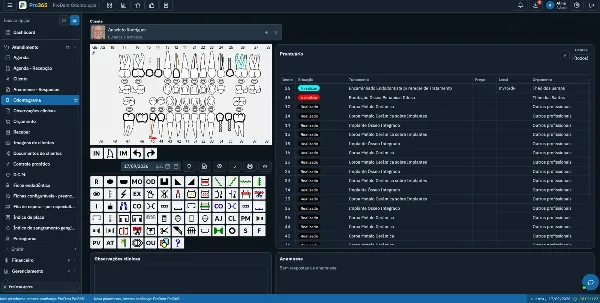
Pro365 GO, the new ProDent that runs 100% on the web, brings appointment confirmations, the schedule and financial control into one system, so you can see these losses and act on them. Book a demo and find out how much organized management can change your numbers.