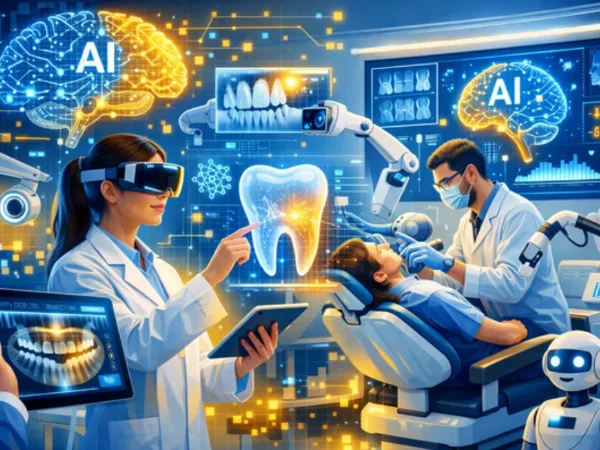
AI-powered dental software is the foundation that lets a clinic use artificial intelligence in day-to-day management. It brings scheduling, patient history, financials and reports into one place, then uses AI and automation to spot patterns, handle routine communication and help owners decide faster.
That shift doesn't happen only in the operatory. It directly affects:
- administrative organization
- patient relationships
- analysis of clinic data
- team efficiency
Meanwhile, clinics that still rely on fully manual methods are finding it harder to keep up with growth and competition. Understanding how clinic software is evolving has become essential for anyone who wants an organized clinic that's ready for what comes next.
From clinical equipment to practice management
Dentistry has always been tied to innovation. Digital equipment, computerized radiography and intraoral scanners have already transformed clinical work.
In recent years, though, the change has moved beyond clinical equipment and into clinic management. Today, software makes it possible to:
- run digital schedules
- track clinic KPIs
- automate appointment reminders
- analyze performance data
That's why dental software is no longer just a nice extra. It has become a strategic tool.
What AI adds to dental clinic software
Artificial intelligence (AI) uses algorithms and systems that analyze data, learn patterns and support decision-making. Inside clinic software, that means the system helps owners and office managers understand how the clinic is really running.
Some examples:
- analyzing scheduling behavior
- identifying no-show patterns
- suggesting better use of appointment slots
- automating communication
First, the technology works through large volumes of data. Then it presents information that helps managers make faster, safer decisions.
How software keeps the clinic organized
Staying organized is one of the biggest challenges in running a dental clinic. Without structured processes, problems pile up:
- confusing schedules
- lost information
- financial headaches
- rework for the team
Software reduces these problems by centralizing key information. The main benefits are:
Centralized data
Important information is recorded in one place and available to the whole team.
Fewer operational errors
Automated processes cut down on forgotten tasks and human error.
A more productive team
With fewer manual tasks, the team gets more done and can focus on strategic work.
See how Pro365 AI can support your management.
Everyday automation
Automation is one of the biggest changes software brings. Processes that used to depend entirely on someone remembering to do them can now run on their own, for example:
- sending appointment reminders
- confirming the schedule automatically
- post-visit messages
- recall follow-ups
These automations help reduce no-shows, improve communication and save the team's time. The software doesn't replace people; it makes their work more efficient.
Where the software fits in the bigger technology picture
In a clinic's digital transformation, the software is the main organizing tool. It centralizes the information behind daily operations, including:
- dental scheduling
- treatment records and patient history
- clinic financials
- reports and KPIs
Some systems also include automation features that make patient relationships easier to manage:
- new-patient campaigns, with scheduled messages after the first appointment
- automatic appointment reminders
- ongoing automated follow-up, with periodic recall and relationship messages
With these tools, the clinic stays in touch with patients without overloading the team. The software becomes the base that organizes data, supports processes and makes room for further innovation in management.
How to prepare your clinic for what's next
Technology in dentistry will keep evolving quickly. Owners and office managers can start preparing with a few simple steps.
1. Digitize administrative processes
Avoid paper records and keep information in digital tools.
2. Track your clinic KPIs
Data-driven decisions tend to be more effective.
3. Get your schedule organized
A well-structured schedule improves patient flow.
4. Train your team on new technology
Technology only delivers results when people know how to use it properly.
The right software is what makes AI useful
Digital transformation is already changing how dental clinics run. Software helps you:
- organize processes
- improve the patient experience
- boost team productivity
- make data-driven decisions
Clinics built on solid dental software adapt more easily as the market changes.
Pro365 GO, the new ProDent that runs 100% on the web, brings scheduling, KPIs and patient communication together, with Pro365 AI built in. Book a demo to see how it can support your clinic's growth.