A dental treatment estimate is the written document that lists the procedures recommended for a patient, the fee for each one, the payment terms, the expected timing and how long the quote is valid. To write a good one, start from the diagnosis recorded on the dental chart, give every procedure its own line, and spell out fees and reasonable alternatives so the patient can make an informed decision.
What is a dental treatment estimate, and how is it different from a treatment plan?
The treatment plan is the clinical decision: what each tooth needs and in what order. The treatment estimate turns that plan into fees, timing and payment terms, in a document the patient can take home, compare and accept.
One plan can produce more than one estimate, for example an implant option and a removable partial denture option. Once accepted, the estimate is what both sides agreed to, so every line deserves care.
What should a dental treatment estimate include?
The ADA Code of Ethics asks dentists to inform patients of the proposed treatment and any reasonable alternatives (1.A) and not to represent fees in a false or misleading manner (5.B). In practice, a complete estimate has these fields:
| Field | What to write | Why |
|---|---|---|
| Practice and dentist | Name, address, phone, treating dentist and license number | The patient knows who is providing care |
| Patient | Full name and date of birth | Avoids mix-ups between patients |
| Number and date | Sequential number and issue date | The expiration date counts from here |
| Procedures | Tooth, surface, procedure and CDT code, one per line | Itemized fees are clear and easy to check |
| Fee per line | Fee for each line and subtotal | The patient sees what each item costs |
| Materials | Implant system, crown type or material when it changes the fee | Explains price differences between options |
| Phases and timing | Order of phases and expected number of visits | Helps the patient plan time and money |
| Insurance | Estimated plan portion and patient portion, shown separately | Insurance amounts are estimates until the claim is processed |
| Payment terms | Pay in full, down payment, number of payments, schedule | Avoids surprises at checkout |
| Discount | Percentage or amount and the condition (e.g., paid in full) | One rule for the whole team |
| Expiration | Date the estimate expires | Fees and plans change |
| Not included | Lab fees, imaging or outside specialists not in the total | No surprise bills later |
| Alternatives | Other reasonable options, with fees | ADA Code 1.A |
| Acceptance | Date and signature of patient and dentist | Records what was agreed |
How to write a dental treatment estimate, step by step
Following the same order every time makes estimates faster and catches omissions:
- Finish the diagnosis on the dental chart. Record existing work and everything that needs treatment, tooth by tooth.
- Turn each finding into a line. One procedure per line, with tooth and surface: "#19 – composite restoration, MO".
- Apply the right fee schedule: your full fee or the patient's in-network fees.
- Group the lines into phases. Urgent care first (pain, infection), then foundation work (periodontal therapy, endodontics, restorations), then restorative and cosmetic care.
- Build the options when there is more than one reasonable clinical path.
- Set the payment terms within your practice's financial policy.
- Add the expiration date and what is not included.
- Review it with the patient on screen, record the status and collect the signature.
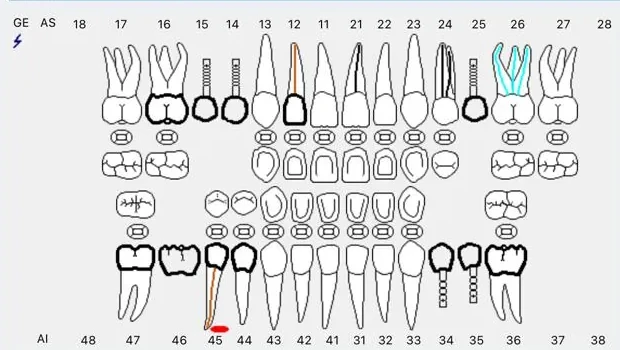
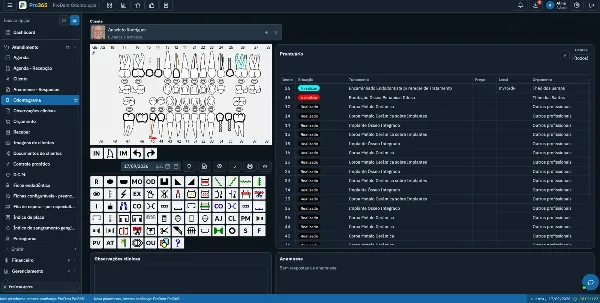
On paper, the dentist charts the mouth and someone at the front desk types it all again into the estimate. With digital dental charting, the charted procedures become the estimate lines.
Do you need to give a Good Faith Estimate?
For uninsured or self-pay patients, often yes. Under the No Surprises Act, CMS explains that if a patient isn't using health insurance to pay, the provider must give a good faith estimate of expected charges when the patient asks or when care is scheduled at least 3 business days in advance. The estimate must be itemized, and it is due within 1 business day when care is scheduled 3 to 9 business days ahead and within 3 business days when it is scheduled 10 or more days ahead or requested.
The CMS FAQ on good faith estimates mentions dental care directly: when there is no relevant diagnosis code, such as for certain dental screenings or procedures, the estimate still must include expected charges and service codes. The same FAQ says the estimate is part of the patient's record, and that a patient billed $400 or more above it may start the patient-provider dispute resolution process. Review the full requirements with your compliance advisor.
How to show payment plans, discounts and financing
Payment terms belong on paper before the patient decides. Include:
- the fee if paid in full and the total under a payment plan;
- down payment, number of payments, schedule and first due date;
- any interest and the rate;
- late fees, if your practice charges them;
- the total the patient will pay under each option.
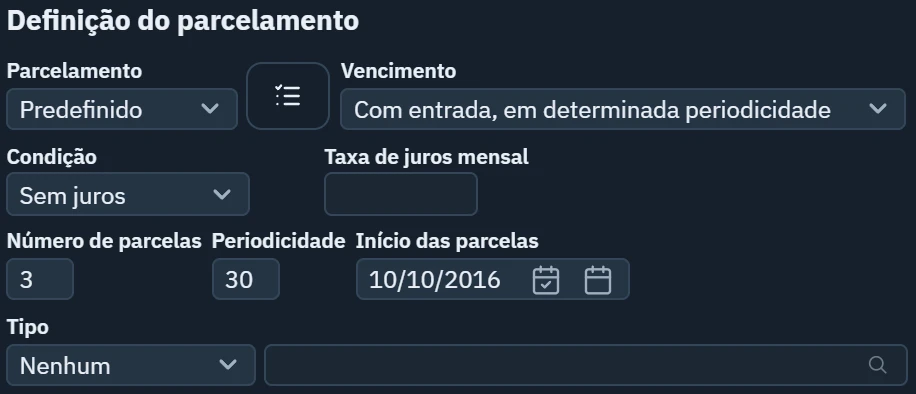
If you offer third-party financing, be careful how it is presented. The CFPB report on medical credit cards and financing plans found that these products, often with deferred interest, can leave patients paying more than they otherwise would. Put your in-house payment plan next to any outside option so the patient can compare.
Write a discount policy: who can offer one, how much and when. Improvised discounts become a habit. The treatment plans and estimates guide covers how to handle cost objections without cutting fees.
How to show phases and treatment alternatives
Splitting the estimate into phases, each with its own subtotal, shows where to start and lets the patient accept phase one while planning for the rest. For each phase, add one plain sentence on what it fixes.
When there are alternatives, put them side by side with what changes: number of visits, expected longevity, fee. That is the practical side of ADA Code 1.A, and it leaves a record of what was explained.
Dental treatment estimate template: a fill-in checklist
Use this structure as your template and check each field before handing it over:
- Header with practice details, dentist name and license number
- Patient name and date of birth
- Estimate number and date
- One- or two-sentence summary of the diagnosis
- Lines: tooth, surface, procedure, CDT code, material when relevant, fee
- Phases with subtotals and expected number of visits
- Alternatives, when they exist
- Subtotal, estimated insurance portion, discount, patient portion
- Payment terms: paid in full, down payment, payments, interest
- Expiration date
- What is not included
- Acceptance line with date and signatures of patient and dentist
How to send, sign and track the estimate
The conversation happens chairside, with the case on screen. Afterward, the patient needs a copy to decide calmly. Send it by text message, email or WhatsApp, whichever the patient prefers, and only to the contact on file, because the estimate reveals health information.
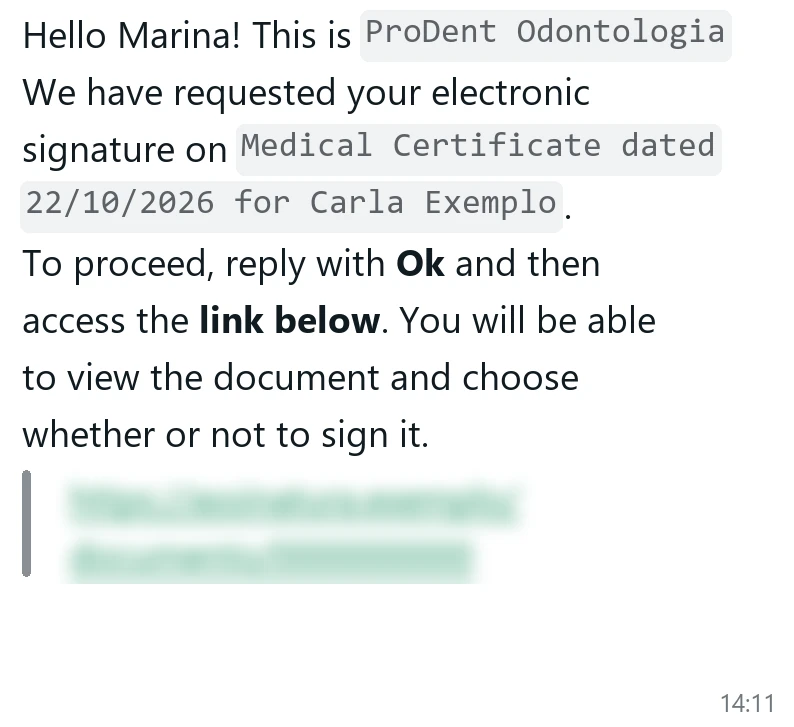
Acceptance should be in writing. A signature on paper or an electronic signature shows what was accepted and when. The same day, record the status: accepted, under review or declined.
Estimates under review need follow-up with an owner and a routine. That topic is covered in unaccepted dental treatment plans.
Common mistakes in dental treatment estimates
- Only a grand total. Without lines, the patient can't see what they're paying for and compares price alone.
- No expiration date. When fees change, nobody knows which number applies.
- Insurance estimate presented as a guarantee. Show it as an estimate, separate from the patient portion.
- Payment plans without a total. Patients need to see what they pay in the end, with and without interest.
- Raising a fee because the patient has dental benefits. ADA Code 5.B.2 calls this overbilling.
- Changing the fee mid-treatment without a new, accepted estimate.
- Only one option when reasonable alternatives existed.
- No status recorded, so the estimate disappears between the operatory and the front desk.
Dental treatment estimates in Pro365 GO
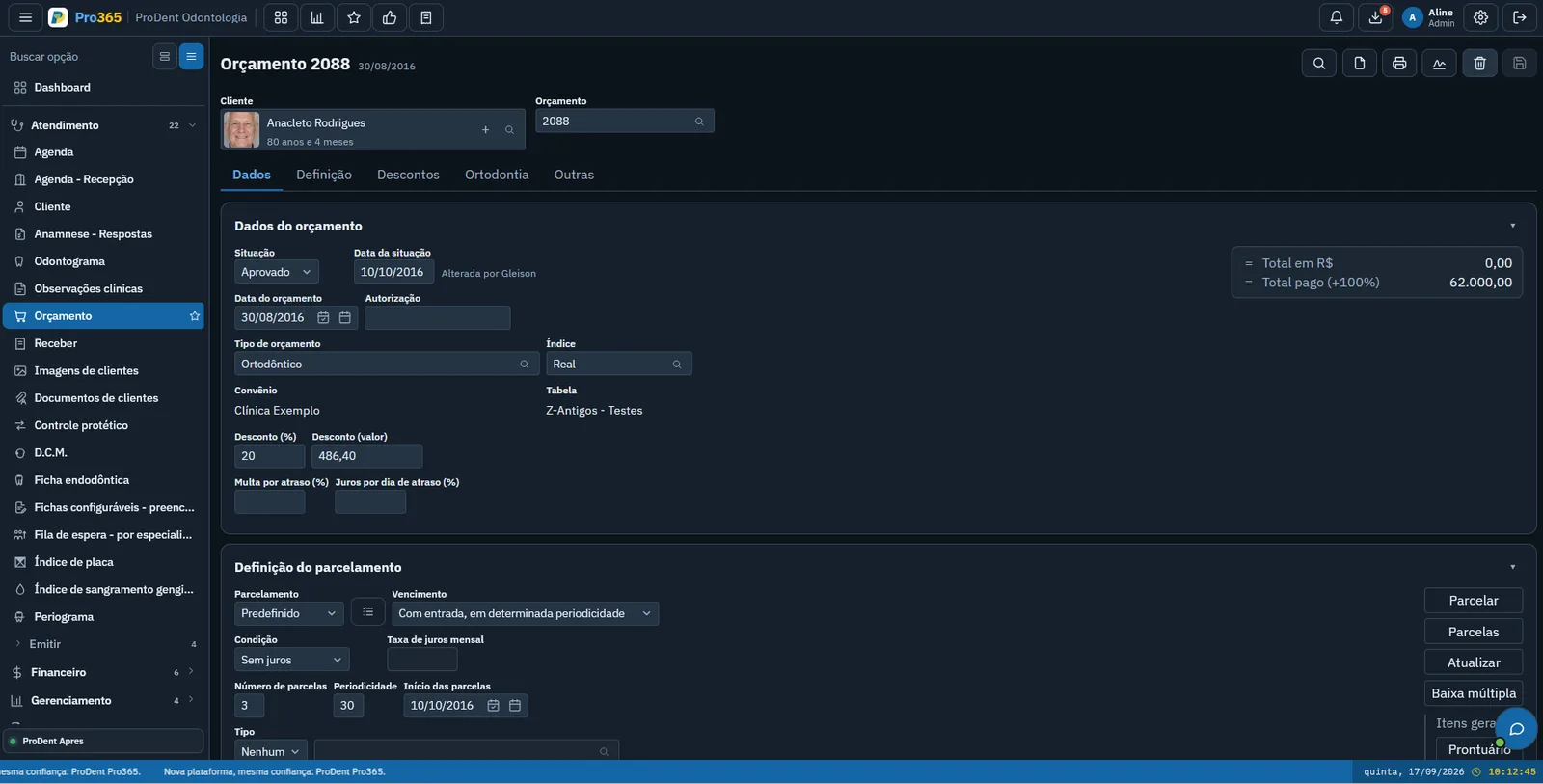
In Pro365 GO, the new ProDent, 100% web, the estimate starts from the dental chart, uses the patient's insurance and price table, and includes discounts as a percentage or amount, late fees and interest, and payment plans with down payment, frequency and with or without interest. Each estimate has a status (accepted, under review or declined) with the date and who changed it; once accepted, it becomes installments in finance, and the patient and dentist sign through a link on their phone with a simple electronic signature. To measure acceptance, see how to increase case acceptance. See dental treatment plans and book a demo to build an estimate with one of your own cases.
Written by the HartSystem team, which has developed ProDent dental software since 1993 and works with practices in Brazil, Portugal, the United States, Mozambique and Paraguay.