Dental clinic business continuity is the ability to keep critical routines running with acceptable quality when someone is out, changes roles or leaves the team. The way to get there is to find where knowledge, authority and context depend on a single person, test coverage before you need it and train real backups through supervised clinic.
A Monday starts with the billing coordinator out on leave. The payments are in the system, but no one knows which discrepancies she had already looked into. The front desk can see the schedule but depends on a colleague to decide which add-ons can go ahead. Two accepted treatment plans are waiting on a handoff that everyone only half understands.
The clinic is still open. Even so, part of the operation has stopped.
This kind of vulnerability is usually treated as a problem of absence, training or commitment. In reality, it's a management design problem. When an important routine depends on the memory, judgment or informal passwords of one person, the business doesn't just have an experienced employee. It has a single point of failure.
The goal isn't to make people replaceable. It's to keep knowledge, authority and context from being trapped with one person. The mature question isn't "who can do this task?" It's "who can take on this responsibility, understand the exceptions and deliver a reliable result without depending on improvised instructions?"
The risk isn't the person, it's the concentration
Knowledge management starts by prioritizing what is both critical and vulnerable. It also helps to separate knowledge that lives in people, knowledge that's written down and knowledge built into processes and tools. For a clinic, the lesson is direct: a manual covers only part of the risk. Tacit knowledge, such as spotting an exception, reading the context or choosing between two possible answers, has to be passed on through interaction and supervised clinic.
So the owner shouldn't start by asking which documents are missing. Start by locating where an interruption would cause real harm. A routine is critical when stopping it affects patient care, safety, cash, patient experience, compliance, reputation or the ability to make decisions. It's vulnerable when few people know how to do it, the criteria aren't clear or the team has never tested a real handover.
ISO 22301 organizes business continuity around business impact analysis, risk assessment, competence, response and testing. ISO's own overview of the standard stresses that only structured exercises give objective assurance that arrangements will work when required. For a clinic, that changes the question from "do we have a backup?" to "has this person run the process under realistic conditions and shown they can get operations back on track?"
Run the 48-hour test
Pick someone who holds important decisions and imagine they'll be unavailable for the next 48 hours, not answering messages. Don't use the exercise to evaluate that person. Use it to evaluate the system of work.
Look for five signals.
- The team knows what has to keep moving. There's clarity on the deliverables that can't wait, such as confirming a fragile schedule, completing the handoff of an accepted treatment plan, checking a daily close or answering an important patient request.
- The records let someone rebuild the context. The person stepping in finds the current status, history, prior decision, open item and next step in the authorized system, without hunting through personal messages or side spreadsheets.
- Authority comes with the task. The backup knows how far they can decide, when to escalate and who owns the result while responsibility is transferred.
- Exceptions have criteria. The routine doesn't only work in the ideal case. The team knows what to do when data is missing, there's a scheduling conflict, a financial arrangement falls outside the norm or a patient asks for something outside what was agreed.
- Recovery can be measured. The clinic can check time to resume, rework, first-attempt errors and the effect on patients, the schedule or cash.
If two or more of these signals fail, the clinic doesn't need a longer manual. It needs a business continuity plan for that routine.
Build a map of critical routines
The map should be small enough to guide decisions. Start with the routines that connect areas and, if interrupted, cause losses down the line.
Daily and monthly financial close. Within 48 hours, cash decisions can be delayed and discrepancies go unresolved. The concentrated knowledge usually involves checking criteria and the history of open items. The evidence needs to live in the financial records, with owners and explanations. Coverage only exists when someone else can do it under supervision and, later, with demonstrated independence.
Accepted treatment plan to start of treatment. An interruption leaves the patient without a next step and adds uncertainty about future revenue. The map should make visible the handoff rule, the required documents, the priority, the plan's status, the contact, the task and the owner. Coverage needs to include a normal case and a likely exception.
Schedule with no-shows and add-ons. The key person's absence can create idle capacity or conflicting decisions. The critical knowledge lies in the criteria for confirmations, add-ons and escalation. Schedule status, history and contacts need to let someone else decide without relying on an outside message.
Handling a complaint. The clinic risks giving inconsistent answers and making an experience problem worse. The backup needs to know the context, the limits of what they can offer and the escalation channel. Coverage is proven when they can listen, route the issue and close the loop with enough of a record for someone else to continue.
Don't confuse coverage with access. Giving someone permission doesn't transfer judgment. And don't confuse documentation with mastery. A written procedure helps people remember the steps, but it doesn't prove someone can do the work, recognize an exception and decide responsibly.
Transfer capability, not just instructions
In Deloitte's 2025 Global Human Capital Trends research, two-thirds (66%) of managers and executives said most recent hires weren't fully prepared, and lack of experience was the most common shortcoming. In the same research, 73% of executives and 72% of workers said organizations should do more to help people build experience.
That matters for a clinic because classroom-style training doesn't close the experience gap. Deloitte defines experience as the ability to apply skills, knowledge and human capabilities in real conditions. It also found that managers spend, on average, just 13% of their time on tasks such as hiring and onboarding.
In practice, handing over a critical routine needs to produce four pieces of evidence.
- The person explains the reasoning. They don't just repeat the steps. They can say what they look for, which risks they weigh and when they stop the flow.
- The person handles a real case. Learning happens inside the process, with authorized data, a real deadline and visible consequences.
- The person faces a controlled exception. The manager presents a likely variation and watches whether the backup recognizes limits, checks the right source and escalates at the right time.
- The person closes the loop. The final record lets someone else reconstruct what happened and pick it up later.
This logic applies to administrative routines and also to handoffs that affect care. AHRQ defines a handoff as a standardized way of transferring information, along with authority and responsibility. Its guidance makes clear that the person handing off stays accountable until the other party knows they're taking on the responsibility. In a dental clinic, that means leaving a note isn't enough. The person receiving the handoff needs to acknowledge it, understand the next step and know which situations require going back to the previous owner or to leadership.
The right metric measures readiness
A clinic can track plenty of KPIs and still only discover its fragility during an absence. To reduce that risk, add readiness measures to your management review.
- Coverage of critical routines: the percentage of priority routines with at least two people who have already shown they can do them
- Time to resume: the time between the owner of a routine becoming unavailable and the routine running reliably again
- First-time-right execution: the share of cases completed without later correction
- Handoff rework: time spent rebuilding context, finding information or redoing entries
- Balancing effect: the impact of coverage on team workload, visit times, patient experience and record quality
Don't turn these measures into an individual ranking. They assess how resilient the process is. If time to resume is high, the cause may be documentation, access, data quality, how authority is designed, insufficient training or too many exceptions. The management decision should target the mechanism, not look for a convenient person to blame.
There's another current warning sign. In Deloitte's 2026 Global Human Capital Trends, only 8% of respondents said their organizations are highly effective at meeting the workforce's continuous learning needs. For a clinic, the consequence is practical: knowledge transfer shouldn't happen only at onboarding or when someone gives notice. It needs to be part of the routine, through small exercises, case reviews, cross-training and coverage tests.
In healthcare, continuity also requires coordination
The World Health Organization includes team communication and coordination, effective handover between providers, checklists and building health worker competency among the tools for improving clinical quality. Applying this means respecting each role's scope. Business continuity in a dental clinic doesn't allow someone without clinical training to make clinical decisions. It requires administrative, treatment coordination, financial and clinical responsibilities to be clearly defined, records to stay accessible to authorized people and handoffs to preserve context without crossing professional boundaries.
That care avoids two extremes. In the first, everything depends on the owner or one experienced employee. In the second, the push for standardization spreads access and responsibility without criteria. A mature operation combines coverage with governance.
Where HartSystem, ProDent and Pro365 AI fit in
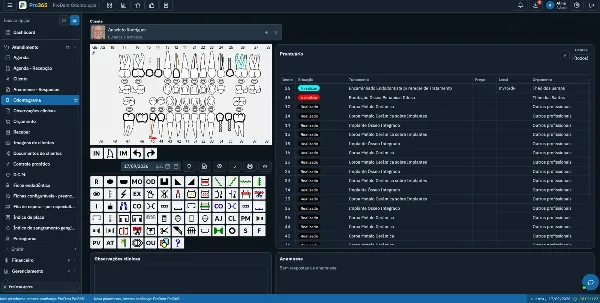
ProDent is a platform that brings together scheduling, financial management, digital patient records, CRM, management dashboards, marketing and performance. It also includes the Pro365 AI Instructor, which guides the team on how to use the system, and the Pro365 AI Consultant, which answers questions about the clinic's own data, along with personalized consulting and hands-on support.
That combination can support business continuity when the clinic turns it into an operating discipline.
- The system helps keep history, status and data in the authorized workspace
- Management dashboards help spot changes that shouldn't depend on one person's perception
- Pro365 AI can shorten the path to answers about using the system and reviewing data, within the scope HartSystem describes
- Personalized consulting and hands-on support can help review setup, record quality, training and process adoption
The limit matters. Technology doesn't transfer judgment automatically, doesn't define internal authority and doesn't fix a process that lives outside the system. The owner is still responsible for choosing the critical routines, protecting data, validating access, developing backups and tracking results.
One decision for this week
Choose a routine that only one person can do safely. Run the 48-hour test, note where continuity breaks down and pick a real backup. Then run a supervised session, include a likely exception and measure how long it takes to get the routine back on track without significant rework.
If your clinic uses ProDent, bring that process to a conversation with HartSystem's consulting or support team. Instead of asking for generic training, show the routine, the point where context gets lost, the records you have and the evidence that will prove independence.
A clinic that's ready to grow isn't one where everyone can do everything. It's one where critical knowledge has a home, context, owners and enough coverage for operations to keep going without improvising. Pro365 GO, the new ProDent that runs 100% on the web, keeps that context in one place your whole team can reach. Book a demo.