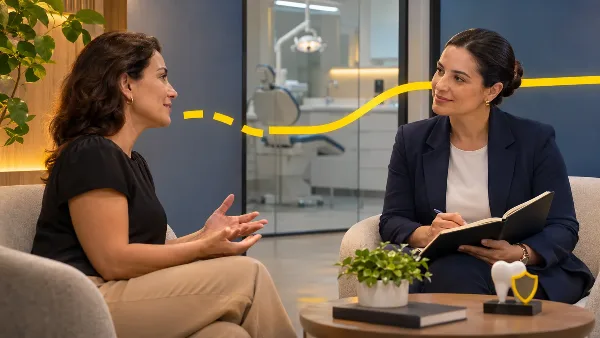

Trust in dental practice management doesn't mean you stop checking. It means giving your office manager clear authority, known limits and reliable information, then following up through samples and variances instead of redoing every decision. When that's in place, the owner can step away from daily operations without every decision landing back on their desk.
In some practices, every decision goes back to the owner, even after a formal office manager role exists. The team asks permission for small exceptions, the office manager avoids taking a position and the owner reviews messages, the schedule, the numbers and agreements that should already belong to someone else.
From the outside, that looks like diligence. Inside, it usually produces a bad mix: slow decisions, weak local leadership and an owner who can't step away without feeling that something will be left unanswered.
You won't fix it by asking the owner to "trust more" or by telling the office manager to "take more initiative." Operational trust in a dental practice isn't a feeling. It's a working relationship built on clear authority, reliable information, verifiable commitments and the ability to fix problems without hiding what happened.
Why do owners and office managers get stuck?
The owner believes they need to review because they still find mistakes. The office manager believes they shouldn't decide because their choices can be reversed without explanation. Both have evidence for their position, and both keep the stalemate going.
When the owner corrects everything personally, the office manager has less room to learn. When the office manager sends every question back, it reinforces the idea that they aren't ready. The practice ends up measuring trust by the absence of problems, a standard no real operation can meet.
Gallup's Singapore Workplace Report 2026 combined employee engagement data, interviews with leaders of Singapore employers and a roundtable with senior executives to look at the role of managers. In the roundtable, one group summed up manager development as "The Three Es": engage, enhance and empower. Empower means delegating authority and giving managers the autonomy to make decisions, while engage covers trust, commitment and regular one-on-one conversations. The report isn't a picture of dentistry, but it shows why autonomy without development, and commitment without authority, both fall short.
For a dental practice, the translation is direct. The office manager needs to know what they can decide, have access to the information they need, get feedback on the results and count on the owner when an issue goes beyond their limits. The owner needs to see the process without turning oversight into permanent rework.
Micromanagement vs. empty autonomy: why are they the same mistake?
Micromanagement happens when leadership keeps the decision, the execution and the checking with the same person. Empty autonomy happens when someone receives responsibility but not the criteria, information, authority or backing to act.
Either way, the practice runs on improvisation.
When there's micromanagement
The office manager prepares, the owner redoes. The team learns that a first decision doesn't count until the owner confirms it. Over time, people stop recommending and only escalate problems.
When there's empty autonomy
The office manager decides, then finds out there was an unwritten rule, an unknown spending limit or a partner's preference treated as policy. The mistake wasn't only the person's. It was also in how the responsibility was designed.
Operational trust sits between those extremes. The decision is really delegated, the limits are known, the record lets anyone rebuild the reasoning and reviews improve the system instead of looking for someone to blame. If you're still working out what to hand off and to whom, start with this guide to delegating tasks in a dental practice.
| Micromanagement | Empty autonomy | Operational trust | |
|---|---|---|---|
| Who decides | The owner, even after delegating | The office manager, without criteria | The office manager, within known limits |
| What's missing | Room to learn | Information, authority and backing | Nothing essential: rules, data and records exist |
| What reviews are for | Redoing | Finding someone to blame | Improving the system |
How do you know trust in practice management is working?
Four signs show up in daily operations when trust between the owner and the office manager is working.
The office manager knows which outcome to protect
A task can be done many ways. A clearly protected outcome reduces ambiguity.
On the schedule, for example, the goal isn't just filling slots. It may be protecting continuity of care, team capacity, punctuality and patient access. In billing, the goal isn't just collecting. It may be keeping the context of a payment arrangement, recording the next step and following the policy the practice has set.
Without that clarity, the owner corrects the method because the outcome was never stated.
Decision limits are set before the exception
A limit isn't distrust. It's what lets someone act without checking with the owner every time.
The practice can define decision ranges, situations that need a second look, topics that stay with the treating dentist and financial matters that need a specialist's sign-off. These limits should respect each professional's scope, patient privacy under HIPAA, system access and legal responsibilities.
Information arrives with enough context
"The schedule dropped" isn't useful evidence. Which period, which provider, which appointment status, compared with what, and concentrated where?

Appointments without an updated status, treatment plans with no outcome and incomplete financial records can all distort the picture. That's why our article on the dental management dashboard recommends checking the records before deciding and connecting any change to the schedule, treatment plans, production, collections or payments.
Trust doesn't eliminate checking. It improves the quality of what gets checked.
Mistakes can be discussed without disappearing or becoming a verdict
An office manager who hides a problem to protect their image loses credibility. An owner who treats every mistake as proof of incompetence teaches the team to hide things.
The mature approach separates three questions: what happened, what condition allowed it to happen and what will be different next time. The person stays responsible for their part, but the practice also learns about the process, the same cycle behind knowledge management in a dental practice.
How do you make accountability visible in a dental practice?
In March 2026, Gallup reported that "create accountability" was the lowest-rated leadership competency of the seven it measured, both in leaders' self-ratings and in managers' ratings of their leaders. Only 30% of those managers said their leaders were exceptional or outstanding at holding everyone responsible for performance, and that group was three times as likely to be engaged at work (51% vs. 17%). These are cross-industry survey figures and shouldn't be used as a benchmark for a practice, but the takeaway applies: accountability works when expectations are clear, follow-up is consistent and it isn't reserved for moments of correction.
In a practice, a visible commitment has four parts:
- what will be delivered;
- by when;
- where it will be recorded;
- which situation requires a heads-up before the deadline.
It's simple, but it changes the conversation. "Keep an eye on treatment plans" is vague. "Every pending treatment plan will have an owner, a next step and a date recorded by the end of the business day, and any case outside the payment policy goes to the practice owner" lets you follow up without watching every call.
How does the owner follow up without redoing the work?
The most useful oversight works through samples, variances and consequences.
- Samples: the owner reviews a few complete cases to understand the quality of the reasoning, not every case to replace the office manager.
- Variances: management looks where behavior moved away from what was expected. That might be more no-shows, a treatment plan with no next step, a payment that doesn't reconcile or a recurring delay in a handoff between front desk and clinical team.
- Consequences: the review asks whether the decision protected patients, the team, cash flow, continuity and the quality of the record. One good result doesn't prove the process was sound, and one bad result doesn't automatically prove incompetence.
Every review should end with a clear decision: keep the rule, adjust the limit, train a skill, fix the data or move the decision to the right level. If the office manager's workload is what keeps decisions stuck, look at dental team productivity as well.
Which metrics show trust between owner and office manager?
Operational trust shouldn't become a subjective score handed out by the owner. The practice can watch signals from the system instead of ranking people.
| Metric | What it reveals |
|---|---|
| Decisions sent back with no new facts | How many questions return to the owner out of insecurity alone, with no change in risk, amount or context |
| Decisions reversed because of an unstated rule | Preferences and rules that only surface after the work is done |
| Time to fix a problem | How long the practice takes between recognizing a problem, protecting the patient or the operation and putting the fix in place |
| Commitments with no record or next step | Where trust is being confused with memory or good intentions |
These are metrics the practice tracks on its own, in the management meeting or a simple spreadsheet, not a ready-made report from the software. They help the practice organize its own learning.
What should you test this week?
Pick one decision your office manager should be able to make but that still comes back to you. Instead of answering right away, identify what's missing: the protected outcome, the limit, the information or trust built through practice.
Choose a real case where the office manager can recommend and decide within an explicit limit. Record the reasoning, follow the result and have a short conversation afterward. The goal isn't to prove someone is ready for everything. It's to build evidence that the practice can share responsibility without losing control.
Where do Pro365 GO, Pro365 AI and consulting fit in?
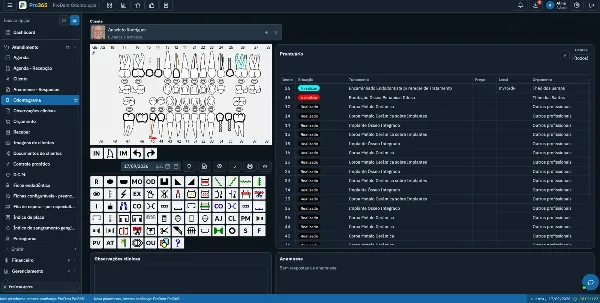
Pro365 GO, the new ProDent, is 100% web-based and brings together scheduling, patient records, treatment plans, billing and a KPI dashboard that compares each number with the previous period. That gives the office manager a way to recover context, follow open items and ask questions based on the records. Pro365 AI Instructor explains over WhatsApp how to do each task in the system, and Pro365 AI Consultant answers questions about the practice's numbers for users who have that permission enabled. HartSystem's support and consulting help with setup, training, record quality and reading the KPIs, in the spirit of consulting that builds autonomy, not dependence.
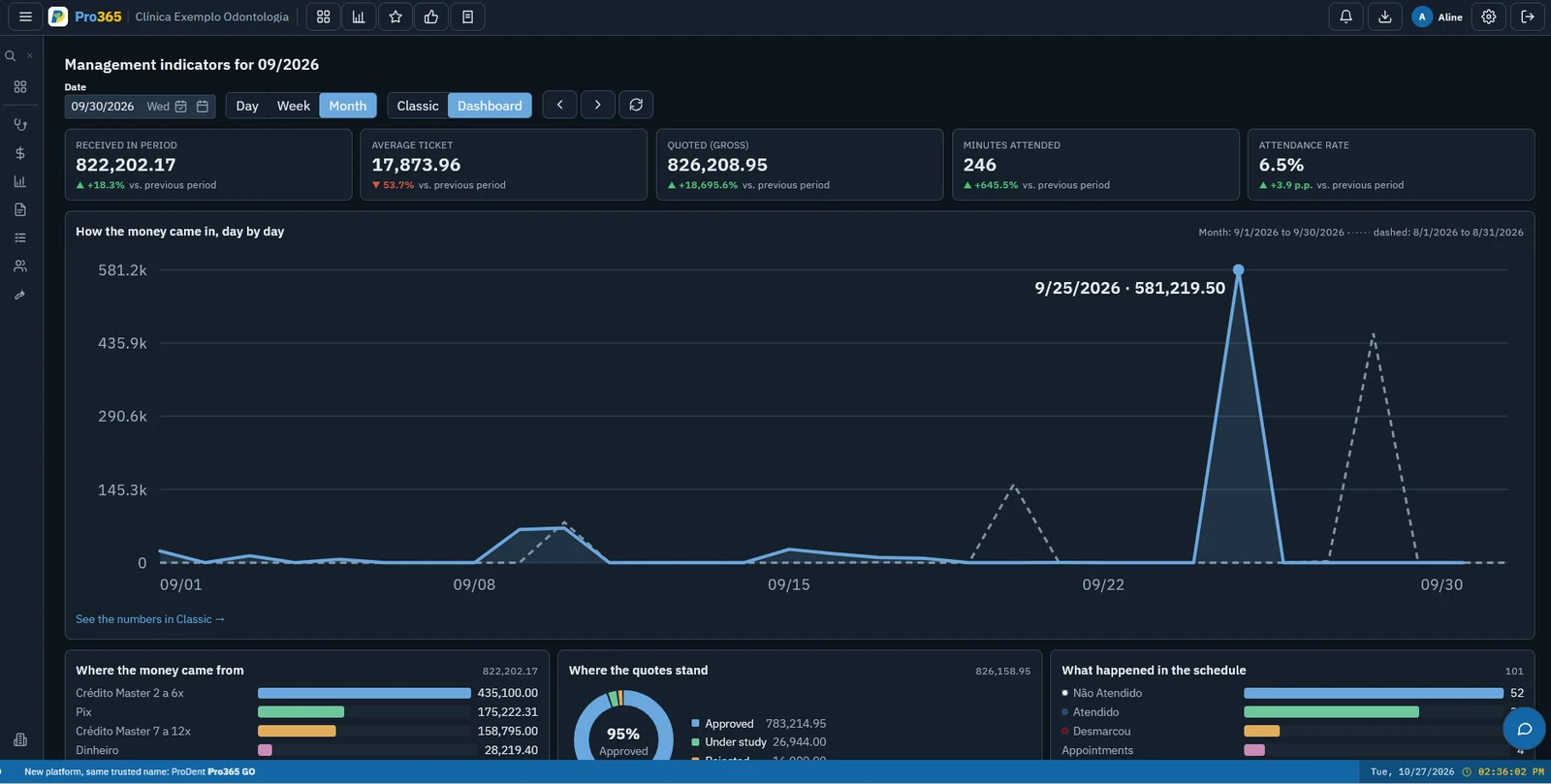
None of these layers sets decision rights, judges character, chooses who deserves trust or replaces the responsibility of the owner and the office manager. The value shows up when the practice turns information into working agreements and uses oversight to build capability.
Book a demo to see the KPIs with your own practice's routine.
Written by the HartSystem team, which has developed ProDent dental software since 1993 and works with practices in Brazil, Portugal, the United States, Mozambique and Paraguay.